DGFT, Customs and Export Compliance Support Across India

Status Holder Certificate and Star Export House Services in India
Get professional support with the eligibility assessment, export-performance reconciliation and recognition as a One Star, Two Star, Three Star, Four Star or Five Star Export House under the Foreign Trade Policy.
Dwarkadhish Overseas supports merchandise exporters, service exporters, deemed-export suppliers and eligible double-weightage applicants with automatic e-SHC review, DGFT profile correction, ANF 1B preparation, CA certification, export-data reconciliation, higher-status upgrades and certificate-related compliance.
What Is a Status Holder Certificate?
A DGFT Status Holder Certificate is a recognition granted under the Foreign Trade Policy to exporters that have achieved the prescribed level of export performance.
Recognised exporters are categorised as:
One Star Export House
Two Star Export House
Three Star Export House
Four Star Export House
Five Star Export House
The objective is to recognise exporters that have made a significant contribution to India’s international trade and can provide guidance and support to new exporters.
Certificate
Status Holder Certificate and Star Export House Certificate
“Status Holder Certificate” is the formal policy term.
The following terms are commonly used by exporters and generally refer to the same recognition framework:
Star Export House Certificate
Export House Certificate
One Star Certificate
Two Star Certificate
DGFT Star Certificate
Status House Certificate
Website content should use both common and official terms naturally, but application documents should refer to the Status Holder Certificate.
Checklist
Current Status Holder Categories and Thresholds
Under the current Foreign Trade Policy 2023, the export-performance thresholds are:
Status category
Export-performance threshold
One Star Export House
USD 3 million
Two Star Export House
USD 15 million
Three Star Export House
USD 50 million
Four Star Export House
USD 200 million
Five Star Export House
USD 800 million
These are the current FTP 2023 thresholds and supersede older threshold tables that may still appear in outdated online articles or legacy DGFT FAQs.
Important warning for website users
Older information may show:
- Two Star at USD 25 million
- Three Star at USD 100 million
- Four Star at USD 500 million
- Five Star at USD 2,000 million
Those were older thresholds and should not be used for a current FTP 2023 assessment.
Export-Performance Period
For most exporters, eligibility is assessed using export performance during:
- The current financial year, and
- The preceding three financial years.
For the Gems and Jewellery sector, the current financial year and preceding two financial years are considered.
The current FTP also requires export performance in each of the three preceding financial years, or each of the two preceding financial years for Gems and Jewellery exporters.
Practical implication
An exporter may cross the total USD threshold but still require further assessment where:
- One of the prescribed preceding years has no export performance
- Part of the turnover consists of ineligible re-exports
- Export proceeds remain unrealised beyond the permitted period
- Export performance belongs to another IEC
- The exporter counted the same shipment twice
Eligibility
Example of One Star Export House Eligibility
Suppose an exporter has the following eligible performance:
Financial year
Eligible exports
Current year
USD 0.50 million
Previous year 1
USD 1.10 million
Previous year 2
USD 0.90 million
Previous year 3
USD 0.70 million
Total
USD 3.20 million
The total exceeds the current One Star threshold of USD 3 million. Final eligibility will still depend on:
- Export realisation
- Eligible export category
- IEC ownership
- Re-export exclusion
- Year-wise performance requirement
- DGFT data and supporting records
value
Which Export Values Are Counted?
The calculation can include eligible:
- Merchandise exports
- Service exports
- Deemed exports
- Specified receipts in Indian Rupees permitted under the FTP
- Exports from eligible SEZ, EOU, EHTP, STP or BTP units connected with the IEC
- Exports under DGFT authorisations
- SCOMET exports
The ANF 1B export-performance statement separately records merchandise exports, service exports, double-weightage exports, deemed exports, permitted INR receipts and eligible unit exports.
performance
Merchandise Export Performance
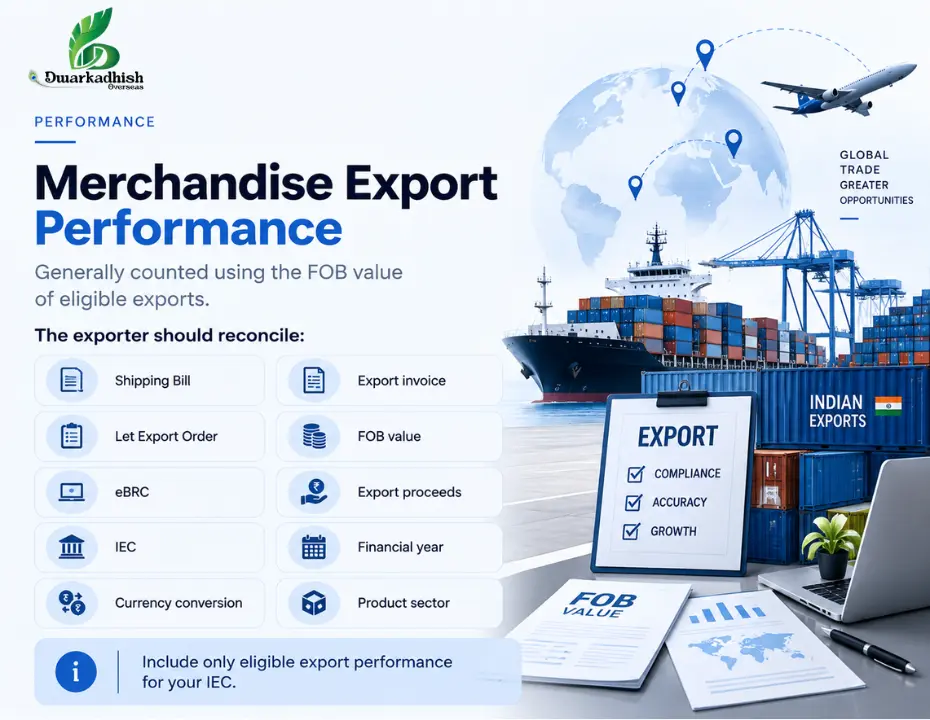
Merchandise export performance is generally counted using the FOB value of eligible exports.
The exporter should reconcile:
- Shipping Bill
- Export invoice
- Let Export Order
- FOB value
- eBRC
- Export proceeds
- IEC
- Financial year
- Currency conversion
- Product sector
Only eligible export performance belonging to the applicant IEC should be included.
export
Service Export Performance
Service exporters are eligible for Status Holder recognition when the prescribed foreign-exchange earnings and other conditions are met.
ANF 1B includes service-export earnings and categorises service transactions according to the recognised modes of supply.
Service-export documents may include
- Service invoices
- Agreements or work orders
- Foreign Inward Remittance Certificates
- Bank advice
- eBRC
- IRM details
- International credit-card settlement certificate
- Ledger and financial statements
- CA, CMA or CS certification
The professional certificate must confirm that foreign exchange was earned through the supply of services from India and that the supporting records were examined.
Deem
Deemed Export Performance
Eligible deemed-export supplies can be counted using the FOR value converted into USD according to the applicable CBIC exchange-rate method.
The exporter should maintain:
- Supply invoice
- Deemed-export category
- Recipient details
- Payment evidence
- Project or authorisation records
- FOR value
- Applicable exchange rate
- Professional certification
Current FTP provisions require deemed-export values in Indian Rupees to be converted into USD using the applicable CBIC exchange rate as on 1 April of each financial year.
Receipt
Export Receipts in Indian Rupees
Eligible export receipts realised in Indian Rupees may be counted where they are permitted under the relevant Foreign Trade Policy provision.
ANF 1B provides a separate format for:
- Eligible INR export receipts
- Exports through permitted banking mechanisms
- Conversion into equivalent USD
- Professional certification
The exporter should not include ordinary domestic turnover merely because payment was received in Rupees.
Weightage
What Is Double Weightage?
Double weightage allows eligible export performance to be counted twice for determining One Star Export House status.
It is not available for determining Two Star, Three Star, Four Star or Five Star recognition.
Under the current FTP, double weightage may apply to eligible exports by:
- Micro and Small Enterprises
- Manufacturing units having ISO or BIS certification
- Units located in North Eastern States, including Sikkim
- Units located in the Union Territories of Jammu and Kashmir and Ladakh
- Exports of fruits and vegetables under Chapters 7 and 8 of ITC-HS
A shipment or service transaction can receive double weightage only once, even where it may appear to satisfy more than one category.
Important MSME Clarification
The current FTP text grants double weightage to Micro and Small Enterprises.
A medium enterprise should not automatically assume double-weightage eligibility merely because it holds an MSME or Udyam Registration.
The Udyam category and its validity during the relevant export period should be checked before including the benefit.
Double-Weightage Example
Suppose a qualifying Micro Enterprise has actual eligible exports of USD 1.60 million. If all those exports meet the applicable double-weightage conditions:
Eligible weighted performance = USD 1.60 million × 2 = USD 3.20 million
The exporter may cross the USD 3 million One Star threshold, subject to:
Year-wise export requirements
Valid Micro or Small status
Realisation
No duplicate weighting
Correct CA certification
DGFT acceptance
Double weightage does not change the actual export turnover in the company’s financial statements. It applies only to the Status Holder eligibility calculation.
Which Exports Are Not Counted?
The following should not be included:
Re-exports
Exports made on a re-export basis do not count toward Status Holder recognition.
Export performance transferred from another IEC
The performance of one IEC cannot be transferred to another IEC.
Export performance based on a disclaimer is not permitted for Status Holder calculation.
Duplicate shipments
The same shipment cannot be counted more than once.
Ineligible domestic turnover
Domestic sales do not become export performance merely because the customer is export-oriented.
Unrealised or unsupported export earnings
Export performance should be supported by appropriate realisation and banking records.
ANF 1B requires the applicant and certifying professional to confirm that eligible export proceeds were realised in the applicant’s own bank account and that re-exports and disclaimer-based exports were excluded.
Exports Under Authorisation and SCOMET
Eligible exports made under a DGFT authorisation can be counted.
Exports of SCOMET-controlled items may also be included for export-performance calculation, subject to the applicable recognition rules and supporting records.
Holding an authorisation does not automatically make every shipment eligible. The exporter must still satisfy:
IEC ownership
Realisation
Export period
No re-export exclusion
No double counting
Accurate value calculation
Automatic System-Generated Status Holder Certificate
DGFT introduced automatic system-based electronic Status Holder Certificates using available merchandise-export data.
Where the government system has sufficient DGCIS merchandise-export data and relevant risk parameters, the exporter may receive the certificate without submitting a separate application.
The automatic certification exercise is carried out annually based on available export data.
Automatic System-Generated Status Holder Certificate
The applicant is primarily a merchandise exporter
Shipping Bill data is correctly captured
The IEC information is current
No additional service-export value is required
No deemed-export value is required
No double-weightage claim is required
The system-calculated category matches the actual category
When an Online Application or Modification May Still Be Required
An exporter may need to file or modify the Status Holder case where eligibility depends on information not fully available through merchandise-export databases.
Examples include:
- Service-export earnings
- Deemed exports
- Double weightage
- Permitted INR receipts
- SEZ, EOU, EHTP, STP or BTP exports requiring inclusion
- Higher status than the automatically generated category
- Missing merchandise exports
- Data mismatch
- Certificate not automatically generated
- Grouped unit exports linked to the same IEC
DGFT’s automatic-certificate announcement expressly recognised that service exports, deemed exports and double-weightage data may require a later online modification or application.
Automatic e-SHC Review Service
Our automatic certificate review can include:
- Checking whether a certificate was generated
- Confirming the Status category
- Downloading the certificate
- Verifying certificate details
- Comparing DGFT-recognised exports with exporter records
- Identifying missing years or shipments
- Assessing eligibility for a higher category
- Preparing a modification or fresh application
- Reviewing the certificate’s validity dates
Eligibility for One Star Export House
An exporter requires eligible export performance of an least: The performance is assessed over the applicable current and preceding financial-year period. One Star is also the only category for which eligible double weightage is available
Suitable applicants may include : Growing merchandise exporters, Micro and Small exporters, ISO or BIS-certified manufacturers, Fruit and vegetable exporters, Service exporters crossing the threshold, Mixed goods-and-services exporters, Eligible exporters in specified regions.
Eligibility for Two Star Export House
An exporter requires eligible export performance of at least:
USD 15 Million: Double weightage is not available for calculating the Two Star threshold. Two Star and higher Status Holders are also subject to skilling and mentorship expectations under FTP 2023.
Eligibility for Three Star Export House
An exporter requires eligible export performance of at least:
USD 50 Million: Three Star manufacturer Status Holders may also be eligible for specified origin self-certification facilities, subject to the relevant infrastructure, product and procedural conditions.
Eligibility for Four Star Export House
An exporter requires eligible export performance of at least:
USD 200 Million: Four Star status carries the recognition and privileges available under the Status Holder framework, subject to scheme-specific conditions.
Eligibility for Five Star Export House
An exporter requires eligible export performance of at least:
USD 800 Million: Five Star is the highest Status Holder category under the current FTP 2023 framework.
Our Process
RCMC Registration Process
RCMC Council Selection
We identify: Main export product, Service category, ITC-HS or SAC code, Relevant Export Promotion Council, Commodity Board jurisdiction, FIEO eligibility, Exporter category.
DGFT profile review
We check: IEC status, Legal name, Registered address, Branches, Directors or partners, GSTIN, Contact details, Exporter category.
Document collection
A council-specific document checklist is provided.
e-RCMC application
The application is initiated through the DGFT e-RCMC service. The exporter selects: Registering Authority, Council office, Membership category, Branch, Product group, Product or service codes, Membership period.
Document upload
The required documents and the declarations are uploaded.
Electronic signing and payment
The application is signed and the applicable: Entrance fee, Membership fee, GST, Product-panel fee, Additional charges. These are paid through the available online process.
Council review
The Registering Authority reviews: Jurisdiction, Applicant category, Product or service, Supporting documents, Membership charges, Export turnover, Manufacturing status, Sector-specific eligibility.
Certificate issuance
After approval, the e-RCMC becomes available electronically for viewing and download.
RCMC Registration Fees
There is no single identical fee for every Export Promotion Council. The cost mainly depends on factors such as:
- Selected council
- Membership category
- Entrance fee
- Annual subscription
- Membership period
- Export turnover
- MSME status
- Manufacturer or merchant category
- Product panel
- Branch membership
- GST
- Council-specific concessions
Recommended pricing presentation
Dwarkadhish Overseas professional fee
Custom quotation based on the selected council and scope
- Entrance fee
- Annual membership subscription
- GST
- Product-panel fee
- Branch fee
- Turnover-based fee
- Status-based fee
- Amendment fee
- Renewal fee
- Additional council charges
External expenses
- CA certificate
- DSC
- Product licence
- Notarisation
- Translation
- Courier where applicable
- Third-party certification
Pricing disclaimer
The final RCMC cost depends on the selected Export Promotion Council, exporter category, product, turnover, membership period and applicable taxes. Council membership charges and external expenses are separate from Dwarkadhish Overseas’ professional fees.
How Long Does RCMC Registration Take?
There is no single guaranteed processing timeline.
The time required depends on:
- Correct council selection
- Updated IEC profile
- Application completeness
- Product eligibility
- Council workload
- Payment success
- Manufacturing verification
- Additional-document request
- Sector-specific licensing
- Deficiency response
Recommended website wording
Complete applications may be processed promptly, but final issuance depends on the concerned Export Promotion Council or Registering Authority and the applicant’s documents. Do not promise same-day approval unless the selected council officially provides that facility.
RCMC Renewal
RCMC is normally valid for five financial years.
Where continued registration is required after expiry, the certificate should be renewed through the applicable e-RCMC process.
Renewal documents may include
- Existing RCMC
- IEC
- GST Registration
- Product list
- Updated turnover certificate
- Export-performance statement
- Branch information
- Udyam Registration
- Product licence
- Membership-dues confirmation
- Council declarations
RCMC Amendment
An active RCMC should be amended where material information changes.
Common amendments
- Business-name change
- Registered-address change
- Branch addition
- Branch closure
- Ownership change
- Constitution change
- Director or partner change
- Product addition
- Product deletion
- ITC-HS change
- Service addition
- Exporter-category change
- MSME status change
- Status Holder update
- Contact-detail change
A material change in ownership, constitution, name or address should be reported promptly to the concerned Registering Authority.
RCMC Surrender
Surrender may be appropriate where:
- Export business has closed
- The legal entity has been dissolved
- IEC has been surrendered
- Export activity has permanently stopped
- Product activity has moved to another legal entity
- Wrong council registration is no longer required
- Business has merged or been restructured
Before surrendering, review whether:
- Advance Authorisation is active
- EPCG Authorisation is active
- Status Holder application is pending
- Council dues are outstanding
- Another council registration is required
- Amendment is more appropriate than surrender
Ongoing Obligations of an RCMC Holder
An RCMC holder may be required to:
- Follow the council’s membership conditions
- Comply with applicable codes of conduct
- Pay annual membership dues
- Submit export returns
- Submit nil returns where prescribed
- Inform changes in ownership, name, address or constitution
- Maintain product and business records
- Cooperate with council verification
- Maintain valid product-specific licences
- Follow any applicable minimum export price requirement
The exact obligations depend on the concerned council..
De-Registration and Appeal
A Registering Authority may consider de-registration for violation of membership or registration conditions.
Before de-registration, the exporter should ordinarily be provided:
- Notice of the proposed action
- Reason for action
- Opportunity to respond
- Time to provide supporting documents
An exporter aggrieved by an RCMC-related decision may use the applicable representation or appeal route.
Legal appeal work requires a separate professional scope.
Troubleshooting
Common RCMC Problems
Wrong Export Promotion Council selected
The selected council may not cover the exporter’s principal product.
Our approach: We review: Product description, ITC-HS code, Current turnover, Future export plans, Council jurisdiction, FIEO eligibility.
FIEO selected despite clear product jurisdiction
The exporter chooses FIEO even though a specialised council clearly covers the main product.
Our approach: We determine whether the exporter genuinely qualifies as multi-product or uncovered-product.
Main line of business is unclear
The exporter deals in several unrelated products.
Our approach: We compare: Current export turnover, Planned exports, Product range, ITC-HS jurisdiction, Existing council memberships, Dominant business line.
Incorrect ITC-HS code
A wrong classification can lead to incorrect council selection.
Our approach: We compare: Product composition, Technical description, Intended use, Present classification, Council coverage.
DGFT IEC profile is outdated
The e-RCMC application may display: Old address, Old director, Closed branch, Incorrect GSTIN, Wrong contact information.
Our approach: We update or correct the IEC profile before the RCMC application.
Manufacturing evidence is insufficient
The council may not accept only a GST Certificate or Udyam Registration as manufacturing proof.
Our approach: We prepare a council-specific manufacturing-evidence checklist.
Payment succeeded but application remains incomplete
The applicant may have paid the fee but not completed signing or final submission.
Our approach: We verify: Payment transaction, Receipt, DSC or e-sign, Application status, Final submission.
Payment Failure
The payment gateway may not have sent a success response.
Our approach: We review the transaction and council or portal grievance process before making another payment.
Product or council is not visible
Some common causes are: The exporter category is incorrect, Product code is wrong, IEC profile is outdated, Council setting, Product jurisdiction, Portal issue.
Our approach: We verify the Product jurisdiction and the business category before raising any portal issue.
Application is marked deficient
The council may request: Corrected form, Additional documents, Revised CA certificate, Product licence, Export proof, Manufacturing evidence, Updated council fee, Authorised-person proof.
Our approach: We prepare a deficiency checklist and structured response.
Expired RCMC is not visible for renewal
Possible reasons include: Legacy certificate not migrated, IEC mismatch, Wrong DGFT login, Council-record mismatch, Certificate-status error.
Our approach: We reconcile the old certificate, IEC and current e-RCMC profile and determine whether renewal, migration or a fresh application is required.
Active RCMC requires renewal
An active certificate generally requires amendment for present changes. Renewal is normally relevant once the existing certificate has expired.
Ownership or legal constitution changed
An RCMC issued to one legal entity should not simply be used by another entity.
Our approach: We assess: PAN change, IEC change, Legal-entity continuity, Amendment eligibility, Surrender requirement, Fresh RCMC requirement.
Why Dwarkadhish overseas
Why Choose Dwarkadhish Overseas?
Correct council selection
We identify the appropriate Export Promotion Council before filing.
Product-classification review
We review ITC-HS or service classification against the business activity.
Council-specific document checklist
We do not use one generic document list for every applicant.
Complete e-RCMC assistance
Our services cover: Registration, Amendment, Renewal, Surrender, Deficiency response, Status follow-up.
Connected DGFT services
We also assist with: IEC Registration, Certificate of Origin, Advance Authorisation, EPCG Authorisation, Status Holder Certificate, eBRC Management, Export Compliance Outsourcing.
Remote assistance across India
Most document review, filing and application follow-up can be completed remotely.
Related Services
IEC Registration
Obtain or update the IEC required for DGFT applications.
Certificate of Origin
Obtain preferential or non-preferential Certificates of Origin.
Advance Authorisation
Import eligible inputs duty-free against an export obligation.
EPCG Authorisation
Import eligible capital goods against an export obligation.
Status Holder Certificate
pply for One Star to Five Star Export House recognition.
eBRC Generation
Generate and reconcile realisation records required for export-obligation closure.
Export Compliance Outsourcing
Outsource ongoing DGFT, Customs, incentive and authorisation management.
Client Experiences
What Our Clients Say
“Dwarkadhish Overseas supported us with our export documentation and compliance requirements. Their team was responsive and kept us informed throughout the process.”
Nishu Vishwas
[Company Name]
Service: Advance License
“We approached the team for our pending refund-related work. They reviewed the documents carefully and helped us understand the issues and required next steps.”
[Client Name]
[Company Name]
Service: IGST Refund Support
“The team assisted us with DGFT and Customs requirements in a professional and organised manner. Communication and follow-up were consistent.”
[Client Name]
[Company Name]
Service: Export Compliance Support
Pan India
RCMC Registration Services Across India
Dwarkadhish Overseas provides remote and location-specific Advance Authorisation assistance across India.
Mumbai
Delhi NCR
Bengaluru
Chennai
Ahmedabad
Surat
Hyderabad
Kolkata
Pune
Indore
Jaipur
Kochi
Ludhiana
Tiruppur
Rajkot
Coimbatore
Vadodara
Noida
Gurugram
FAQ
Frequently Asked Questions
RCMC stands for Registration-cum-Membership Certificate.
It is issued by a recognised Export Promotion Council, Commodity Board, Export Development Authority or another competent Registering Authority.
No. It is generally required for specified Foreign Trade Policy benefits, concessions and authorisations.
An active IEC linked with the DGFT profile is generally required for online e-RCMC filing.
The council responsible for the product or service forming your principal line of export business should ordinarily be selected.
Yes. Registration is done through DGFT e-RCMC system.
It is normally valid for five financial years.
Documents commonly include IEC, GSTIN, legal-entity documents, product details, turnover records and manufacturing evidence where applicable.
Fees vary according to the council, membership category, turnover, membership period and GST.
Yes. Incorrect jurisdiction, incomplete documents, payment failure or ineligibility may result in deficiency or rejection.