DGFT, Customs and Export Compliance Support Across India

EPCG Authorisation, Compliance and EODC Closure Services in India
The EPCG Scheme helps eligible businesses import or buy machinery for export work. Dwarkadhish Overseas helps you at every step.
We help manufacturers, merchant exporters and service providers apply for EPCG. We check if you qualify and help prepare your application. We also help you get a Chartered Engineer certificate. Our team assists with Customs registration and machinery installation.
We help you track export targets and meet deadlines. If needed, we assist with deadline extensions and licence changes. We also help fix pending issues and complete the EODC process.
Once the export targets are met, we help you close your Customs Bond, LUT or Bank Guarantee.
What Is an EPCG Authorisation?
An EPCG Authorisation is an approval from DGFT. It allows eligible businesses to import or buy capital goods for export work. In return, they must meet the required Export Obligation.
The authorisation may include these details:
IEC holder
Applicant branch
Description of capital goods
ITC-HS code
Quantity and value of goods
Duty Saved Amount
Export product or service
Specific Export Obligation
Average Export Obligation
Installation address
Supporting manufacturer
Customs port of registration
Applicable conditions
Import validity period
Export Obligation period
To apply for a new EPCG Authorisation, businesses must file ANF 5A with the required documents.
What Is the EPCG Scheme?
EPCG stands for Export Promotion Capital Goods. It is a government scheme for businesses that export goods. It helps them buy machinery at a lower cost.
Under this scheme, businesses can import approved machinery without paying Customs duty. They can use it to prepare goods, make products or finish them for export.
The machinery must meet the scheme rules and Appendix 5F conditions. Businesses must also follow the steps set by the government.
Some machinery used for physical exports may also qualify for IGST and Compensation Cess exemptions. These benefits depend on the rules in force.
Businesses can also buy approved machinery from Indian manufacturers. They must follow the required process to claim EPCG benefits.
EPCG Licence Versus EPCG Authorisation
Many exporters, manufacturers, banks and Customs experts use the term EPCG Licence.
DGFT uses the official term EPCG Authorisation.
EPCG Authorisation
You can use both terms on your website for SEO. But use EPCG Authorisation in all official DGFT forms, changes and EODC documents.
Main Benefit of EPCG
The main benefit of the EPCG Scheme is lower import costs. Eligible businesses can import capital goods at zero Customs duty instead of paying the full duty at import.
In return, the authorisation holder must meet these rules:
- Install the capital goods at the approved site.
- Use the goods for the approved purpose.
- Meet the required Specific Export Obligation.
- Maintain the required Average Export Obligation.
- Submit Export Obligation reports when required.
- Get an EODC after meeting the Export Obligation.
- Close the Customs Bond, LUT or Bank Guarantee.
The EPCG Scheme offers more than duty savings. Businesses must also meet their export targets and follow all rules until the process is complete.
What Capital Goods Can Be Covered Under EPCG?
The EPCG Scheme covers different types of capital goods. However, the goods must meet the scheme rules and Appendix 5F conditions. They must also have a clear link to the goods you export or the services you provide.
Eligible items may include:
Complete capital goods
Capital goods in CKD or SKD form
Machinery and production equipment
Pre-production equipment
Post-production equipment
Computer systems that form part of the imported goods
Software that forms part of the imported goods
Spare parts
Moulds and dies
Jigs and fixtures
Tools
Refractories
Catalysts for the first charge
Catalysts for one later charge
Before applying, check that your proposed goods meet the EPCG rules and have a clear purpose in your export work.
Capital Goods Not Permitted or Restricted Under Appendix 5F
Appendix 5F lists capital goods that are not allowed under EPCG. It also lists goods allowed only for certain uses or sectors.
Important Examples
Capital goods
Current EPCG position
Cables
Allowed only as part of capital goods
Railway wagons, except specified specialised tractors
Not allowed
Tractors
Not allowed
Trucks, tippers and dumpers
Allowed only for the mining sector
Motor cars and SUVs
Not allowed
Airport ground-handling equipment
Not allowed
Furniture and certain interior items
Allowed only for certain hotel uses
Construction equipment, such as cranes
Allowed only for providing services
Construction materials, such as sheds, cement and steel
Not allowed
Standalone computers and printers
Not allowed
Second-hand capital goods
Not allowed
Capital goods for the export or supply of electrical power
Not allowed under the listed entries
Certain PUF panels and doors
Allowed only for certain chilled rooms or cold storage
Check the latest Appendix 5F before ordering machinery, paying an advance or filing an EPCG application.
Can Second-Hand Machinery Be Imported Under EPCG?
No.
The current Appendix 5F lists all second-hand capital goods as not permitted under the EPCG Scheme.
Can Computers Be Imported Under EPCG?
The EPCG Scheme does not allow computers or printers imported on their own.
However, they may qualify if they are part of eligible capital goods. The goods must also meet all EPCG rules and conditions.
Who Can Apply for EPCG?
The EPCG Scheme is open to these businesses:
- Manufacturer exporters
- Exporters who work with other manufacturers
- Merchant exporters who use supporting manufacturers
- Service providers
- Eligible Common Service Providers
- Eligible EOU or SEZ units moving to DTA
A merchant exporter can work with another manufacturer. The manufacturer’s name must be on the EPCG Authorisation before the machinery is set up at their site.
Manufacturer Exporter EPCG
A Manufacturer Exporter can apply for the EPCG Scheme. The machinery must be installed at the factory and used to make goods for export.
- The application must show:
- Factory address
- How the goods are made
- List of existing machinery
- Details of new machinery
- Production capacity
- Goods to be exported
- How the machinery will help make export goods
- Past export details
- Ability to meet the Export Obligation (EO)
Documents You May Need
- Factory licence
- Udyam Registration
- Industrial licence or IEM
- GST Registration
- Note on the production process
- List of existing machinery
- Machinery quotation
- Machinery technical details
- Export records
- Chartered Engineer certificate linking the machinery to export goods
Merchant Exporter EPCG
A Merchant Exporter can apply for EPCG with a supporting manufacturer.
The manufacturer must be named in the authorisation before the machinery is installed at their factory.
Documents You May Need
- Merchant Exporter IEC
- Manufacturer's GSTIN
- Factory address
- Industrial registration
- Details of how the goods are made
- Agreement between the exporter and manufacturer
- Details of goods for export
- Machinery installation address
- Chartered Engineer certificate
The certificate must show how the machinery will help make goods for export.
A trading business alone may not qualify for EPCG under this route. The exporter must work with a manufacturer who makes the goods for export.
EPCG for Service Providers
Service providers can apply for EPCG if they meet the scheme rules. The machinery must help them provide eligible services.
These services may include:
- Hotels and hospitality
- Healthcare
- Testing
- Technical work
- Construction
- Logistics
- Professional services
- Infrastructure services
How Is Eligibility Checked?
The type of service and use of the machinery matter. DGFT may also check:
- Proof of service exports
- Foreign exchange earnings
- Where the machinery will be installed
- Type of applicant
- Appendix 5F rules
- Ability to meet export targets
The machinery must support the service. The applicant must also meet the Specific and Average Export Obligations under the EPCG Scheme.
Common Service Provider EPCG
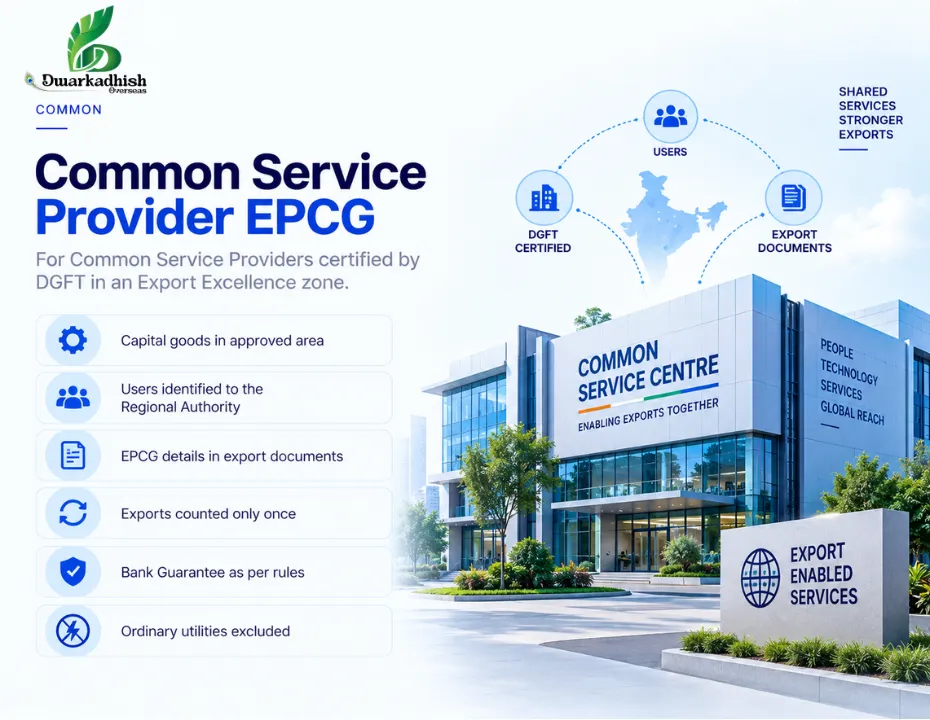
A Common Service Provider may qualify for EPCG if DGFT Headquarters certifies it. The facility applies to providers in a Town of Export Excellence or a PM MITRA Park.
The provider must meet these conditions:
- Install the capital goods in the approved area
- Name the users to the Regional Authority
- Include EPCG details in the required export documents
- Count each export only once
- Provide a Bank Guarantee for the Duty Saved Amount, where required
- This facility does not cover basic utility services. These include electricity, water, sanitation and telephone services
Basic EPCG Eligibility Requirements
Before applying for EPCG, check that your business meets the basic rules.
You should have:
- An active IEC
- An updated DGFT profile
- A valid RCMC, if needed
- Correct GSTIN and branch details
- Eligible exporter or service provider status
- Details of the capital goods
- Machinery quotation or Proforma Invoice
- Technical details of the machinery
- Machinery installation address
- Details of the export product or service
- A clear link between the machinery and exports
- Chartered Engineer certificate
- Past or expected export details
- Ability to meet the Specific Export Obligation
- Ability to meet the Average Export Obligation
- A suitable Customs port
- No DGFT or Customs restriction that blocks the application
Chartered Engineer Nexus Certificate
A new EPCG application needs a nexus certificate from an independent Chartered Engineer. The certificate must follow Appendix 5A.
The engineer checks:
- Description of the capital goods
- Model number
- Technical details
- Quantity of goods
- Installation address
- How the goods will be made or services will be provided
- Product or service for export
- Stage of work where the machinery will be used
- Expected installation waste, if any
The engineer must have the right skills and experience to check the machinery and its use.
Documents Required for a New EPCG Authorisation
The documents you need depend on your business, the machinery you plan to import, your sector and your export target.
Standard documents and information
Document or information
Purpose
IEC Certificate
Confirms your DGFT registration
GST Registration
Confirms your business and work site
RCMC
Confirms your export-sector registration
PAN and Business Documents
Confirms your business identity
Authorised Signatory Details
Shows who can sign the application
Machinery Quotation or Proforma Invoice
Shows the machinery type and cost
Capital Goods ITC-HS Code
Helps classify the imported machinery
Existing Machinery List
Helps check your current capacity and machinery needs
Manufacturing Process Flow
Shows how you make your products
Chartered Engineer Assessment
EO endorsement
Export Product or Service Details
Lists the goods or services you export
Export-product ITC-HS code
Identifies your export products
Export Data for the Previous Three Years
Helps calculate your average export obligation (EO)
Current-year export data
Helps check if you can meet your EO
Existing EPCG details
Shows any pending export obligations
Installation-location documents
Confirms where the machinery will be used
Chartered Engineer certificate
Supports the machinery need and use check
Supporting manufacturer documents
Supports an application by a merchant exporter
Port of registration
Identifies the Customs port for registration
EFC approval
Supports cases that need this approval
Development Commissioner NOC
Supports cases that need approval for an EOU or SEZ unit to move to DTA
Some cases may need extra documents. These may include restricted capital goods or export items, an Appendix 5A nexus report, a merchant exporter application or proof of the actual user location. The exact list depends on your case.
EPCG Application Process
Eligibility assessment
We check if you can apply for EPCG. We review your business type and the machinery you plan to buy. We also check Appendix 5F rules and import details. Next, we review your export products or services, past exports and expected duty savings. We also check your export targets and machinery installation plan.
Duty-saving calculation
We estimate how much Customs duty you can save. We check the machinery value, Basic Customs Duty and other taxes or charges. We then estimate the total duty savings based on the proposed CIF value. This helps us work out your Specific Export Obligation.
Export-obligation assessment
We calculate your Specific Export Obligation (EO) and Average EO. We also check your first-block target and the remaining EO. If you qualify for a lower EO, we review that benefit too. This helps you plan the exports needed to meet the EPCG rules.
Chartered Engineer certification
We help prepare the details needed for the Chartered Engineer nexus certificate. It explains how you will use the machinery. It also shows how the machinery links to your export goods or services.
ANF 5A preparation
We prepare your ANF 5A application with the required details. These include machinery, export products or services and the installation address. We also add the supporting manufacturer's details, duty calculations and Customs port. We include other required records and any request for indigenous procurement, where applicable.
Electronic signing and fee payment
You must digitally sign the application. You must also pay the required DGFT application fee.
DGFT review
DGFT may ask for more details or documents. We help you reply to questions about the machinery, its value, its use or your export products. We also help address issues with classification, the supporting manufacturer or other records.
Authorisation issuance
After DGFT approves the application, you can download the EPCG Authorisation. We check the authorisation and its conditions to help spot errors.
Customs registration
You must register the authorisation at the approved Customs port. Complete this step before clearing the machinery under the EPCG Scheme.
EPCG Government Application Fee
The current application-fee structure is:
₹1 per ₹1,000, or part thereof, of the Duty Saved Amount
subject to: Minimum fee: ₹500 , Maximum fee: ₹1,00,000
The fee is payable separately from professional, Chartered Engineer and Customs-related charges.
Indicative examples
Duty Saved Amount
Indicative DGFT fee
₹50 lakh
₹5,000
₹1 crore
₹10,000
₹2 crore
₹20,000
₹5 crore
₹50,000
₹10 crore or more
Maximum ₹1,00,000
EPCG Professional Charges
New EPCG Authorisation
The starting fee covers a standard EPCG Authorisation application. It applies when:
₹
29,999
/ starting*
- There is one business entity
- The machinery will be installed at one site
- The capital goods are clearly listed
- The technical details are easy to verify
- Export records are ready
- The goods are not restricted under the scheme
- There are no complex past EPCG defaults
- The work includes filing and help with DGFT queries
Separately chargeable items
- Some services are not part of the starting fee. Extra charges may apply for:
- DGFT application fees
- Chartered Engineer certificates
- CA, CMA or CS certificates
- Customs registration
- Bond or LUT preparation
- Bank Guarantee work
- Applications with many types of machinery
- Machinery installed at more than one site
- Adding a supporting manufacturer
- EFC approval
- Indigenous procurement
- Invalidation Letter or Advance Release Order (ARO)
- Installation Certificate
- EPCG Authorisation changes
- Export Obligation tracking
- Block-wise reports
- EO extensions
- EPCG clubbing
- Regularisation of defaults
- Export Obligation Discharge Certificate (EODC)
- Customs Bond closure
- Site visits
- Legal support
Pricing disclaimer
The starting professional fee is ₹29,999 for a standard EPCG Authorisation application.This fee covers only the agreed application work. DGFT fees, certificates and other professional charges are extra. Customs charges, government payments, travel and additional services also cost extra.DGFT approval is not guaranteed. Customs registration, EO extensions and EODC depend on the rules and approval of the relevant authorities.
Import Validity of EPCG Authorisation
An EPCG Authorisation is valid for 24 months from the date of issue. The current Foreign Trade Policy (FTP) does not allow revalidation of the authorisation.
Important planning points
Plan your machinery import well before the 24-month period ends. Make sure you have enough time to:
- Choose a machinery supplier
- Sign the purchase contract
- Make advance payments
- Arrange shipment
- Receive the Bill of Lading
- Register the authorisation with Customs
- File the Bill of Entry
- Clear the machinery through Customs
- Install the capital goods
An expired EPCG Authorisation cannot usually be renewed for further imports under the current FTP. Plan each step carefully to avoid delays.
Actual User Condition
Machinery imported under EPCG must follow the Actual User condition.
This means the exporter must use the machinery as required by the scheme. The condition stays in place until the exporter meets the Export Obligation and gets the EODC.
Until then, the exporter cannot freely sell, transfer or dispose of the machinery. The exporter must follow the EPCG rules.
Registration of EPCG Authorisation at Customs
The EPCG Authorisation has one port of registration for imports. Exporters may use other approved ports to meet their Export Obligation (EO), as per the rules.
Our Customs support may include:
- Review of DGFT data sent to ICEGATE
- Port registration
- IEC and GSTIN checks
- Review of authorisation terms
- Bond or LUT support
- Bank Guarantee support
- Capital goods checks
- Duty-debit tracking
- Bill of Entry checks
- Replies to Customs queries
- Duty Saved checks and matching
Installation Certificate
Exporters must submit the Installation Certificate within three years of completing the imports. This is the time limit set by the current HBP.
The certificate can be issued by:
- The local Customs authority
- An independent Chartered Engineer
If a Chartered Engineer issues the certificate, the exporter must also send a copy to the local Customs authority.
Need More Time?
You can ask the Regional Authority for an extension. The extension may last until the valid Export Obligation period ends. The fee is ₹10,000 for each year of extension.
Documents for the Installation Certificate
Keep these documents ready:
- EPCG Authorisation
- Condition sheet
- Bills of Entry
- Machinery invoices
- Packing lists
- Machinery serial numbers
- Installation address
- Photographs
- Production-process information
- Chartered Engineer report
- Details of existing machinery
- Customs intimation
Our Installation Certificate service
We help exporters prepare and submit their Installation Certificate. Our service may include:
- Review of the import completion date
- Checks of capital goods and records
- Verification of machinery serial numbers
- Verification of the installation site
- Coordination with a Chartered Engineer
- Certificate preparation
- Submission to DGFT
- Intimation to Customs
- Review of late filing cases
Shifting Capital Goods to Another Unit
When moving machinery under the EPCG Scheme, make sure the new factory is eligible. The move must take place during the Export Obligation (EO) period. The new unit must be listed in your IEC and RCMC records.
After moving the machinery, you must submit a new Installation Certificate within six months.
Things to consider before shifting your machinery.
- IEC details of the new unit
- GSTIN details
- RCMC records
- Required DGFT updates
- Customs notice or approval, if needed
- Supporting manufacturer details, if needed
- Deadline for the new Installation Certificate
EPCG Export Obligation
The standard Specific Export Obligation is:
Six times the duties, taxes and cess saved
It must ordinarily be fulfilled within:
Six years from the EPCG Authorisation issue date
The authorisation is also generally subject to an Average Export Obligation.
Specific Export Obligation
Specific Export Obligation (EO) depends on the Duty Saved Amount in the EPCG Authorisation.
Standard formula
Specific EO = Duty Saved Amount × 6
Example
Suppose:
- Duty Saved Amount: ₹50 lakh
- EO multiplier: Six times
Then:
Specific Export Obligation = ₹50 lakh × 6
= ₹3 crore
This is generally in addition to the maintenance of the applicable Average Export Obligation.
Average Export Obligation
Average EO is based on the average exports of the same or similar products over the past three licensing years.
Exporters must usually meet this average each financial year until they complete their Export Obligation (EO).
Only exports above the Average EO usually count toward the Specific EO.
Why this matters
A company may have high export sales but still fail to meet EPCG rules if:
- Its yearly exports fall below the required average
- Exports above the average do not meet the Specific EO
- Exported products do not match those listed in the authorisation
- Exports are linked to a different unit or IEC
- eBRC or proof of payment records are missing
Specific EO Versus Average EO
- Particular
- Specific EO
- Average EO
- Basis
- Duty Saved Amount
- Historical export performance
- Standard amount
- Six times Duty Saved
- Average of preceding three years
- Time period
- Normally six years
- Maintained during applicable EO period
- Product
- Endorsed goods or services
- Same or similar goods or services
- Monitoring
- Authorisation-specific
- Financial-year and block-specific
- EODC impact
- Must be fulfilled or regularised
- Must be maintained or adjusted
Block-Wise Fulfilment of Export Obligation
Under the current EPCG framework, Specific EO is divided into two blocks:
Period from issue date
Minimum Specific EO
First to fourth year
50%
Fifth and sixth year
Balance EO
The holder should intimate the Regional Authority regarding Specific and Average EO fulfilment within three months of completing the block.
First-Block Extension
A request for extension of the first block should ordinarily be submitted within six months after the first block expires.
Composition fee when filed within six months
Duty Saved Amount
Composition fee
Up to ₹2 crore
₹5,000
Above ₹2 crore and up to ₹10 crore
₹10,000
Above ₹10 crore
₹15,000
Composition fee after six months but within six years
Duty Saved Amount
Composition fee
Up to ₹2 crore
₹10,000
Above ₹2 crore and up to ₹10 crore
₹20,000
Above ₹10 crore
₹30,000
Separate regularisation fees can apply where the application is made after the six-year period.
EPCG Export Obligation Report
The holder must submit an online report after expiry of the first four-year block and continue reporting until the valid EO period expires.
The report can contain:
- Shipping Bill number and date
- Export invoice
- Bill of Export
- FIRC
- eBRC
- Export product or service
- Specific EO value
- Average EO value
The statement must be certified by a Chartered Accountant, Cost Accountant or Company Secretary.
Our EO-reporting service
- Authorisation-wise export statement
- Shipping Bill mapping
- Invoice mapping
- eBRC review
- FIRC review
- Specific EO calculation
- Average EO calculation
- First-block fulfilment
- Shortfall identification
- Professional-certification coordination
- Online report filing
Which Exports Can Count Toward EPCG EO?
Subject to the rules, you can meet your Export Obligation (EO) through these types of exports and earnings:
- Direct physical exports
- Permitted third-party exports
- Eligible deemed exports
- Exports under Advance Authorisation, where allowed
- DFIA exports
- Duty Drawback exports
- RoSCTL exports
- RoDTEP exports
- Eligible services
- Royalties received in freely convertible currency
- Foreign exchange earned from R&D services
- Approved Rupee payments
- Certain supplies under ITA-I
- Eligible supplies to SEZ units
Important: Do not count the same export twice toward your Export Obligation. Each export must meet the rules that apply to it.
Third-Party Exports Under EPCG
Third-party exports may count toward the Export Obligation (EO) if they meet the rules. The required documents must also be in place.
Records You May Need
- EPCG Authorisation holder details
- Supporting manufacturer details
- Third-party exporter details
- EPCG Authorisation number
- Shipping Bill
- GST invoice
- eBRC or proof of payment
- Proof of goods movement
- Proof that goods were made at the approved site
- Proof of payment from the third-party exporter to the Authorisation holder
- A declaration to prevent the same export from being counted twice
All export documents must show the correct parties and EPCG Authorisation number.
Reduced Export Obligation
Certain eligible cases can receive reduced Specific EO.
Indigenous procurement
Specific EO is 25% lower than the standard EO.
Green Technology products
Specific EO is 75% of the standard EO.
North Eastern States, Jammu and Kashmir and Ladakh
For qualifying manufacturing units, Specific EO is 25% of the standard EO.
Early EO fulfilment
Where at least 75% of Specific EO and 100% of the applicable Average EO have been completed in half or less than half of the original EO period, the balance Specific EO may be condoned and the authorisation redeemed.
Only one of the specified overlapping benefits is ordinarily available.
Exemption From Average Export Obligation
Exports from these sectors may be exempt from Average EO:
- Handicrafts
- Handlooms
- KVIC industries
- Agriculture
- Aquaculture
- Fisheries
- Pisciculture (fish farming)
- Animal husbandry
- Dairying
- Floriculture (flower growing)
- Horticulture
- Poultry
- Viticulture (grape growing)
- Sericulture (silk production)
- Carpets
- Coir
- Jute
Some fishing trawlers, boats, ships and similar items do not qualify for this exemption.
Capital goods imported under this exemption may have a five-year transfer ban. This ban may continue even after the Export Obligation (EO) is complete. Tools are not covered by this ban.
Indigenous Procurement Under EPCG
An EPCG holder can buy eligible capital goods from an Indian manufacturer in two ways:
- Through an Invalidation Letter
- Through an Advance Release Order (ARO)
Rules for Indigenous Procurement
- EO is based on the notional Customs duties, taxes and cess saved on the FOR value.
- Specific EO is 25% lower than the normal Specific EO
- Average EO stays the same, where it applies
- The Indian manufacturer may qualify for deemed-export benefits under the applicable rules
Our Indigenous Procurement Service
We help with each step of the process, including:
- Checking the supplier and machinery
- Reviewing capital-goods details
- Calculating duty savings
- Applying for an Invalidation Letter
- Coordinating the ARO process
- Identifying suitable Indian suppliers
- Recalculating EO
- Preparing installation records
- Preparing EODC documents
EPCG Amendments
An EPCG Authorisation may need changes after it is issued. These changes may include:
- Adding or removing capital goods
- Changing the capital-goods description
- Changing the quantity or value
- Updating the ITC-HS code
- Adding or removing export products
- Adding a service
- Changing the installation address
- Changing the supporting manufacturer
- Changing the port of registration
- Changing the sector classification
- Updating the Duty Saved Amount
- Updating company details
Changes to Import Items
You can request changes to the import list while the authorisation is still valid for imports.
A new Chartered Engineer nexus certificate may be needed. You may also need to explain why the change is required.
Changes to Export Items
You can request changes to the listed export goods or services while the EO period is still valid. The capital goods must also be linked to the new export item or service.
Automatic Reduction or Enhancement Based on Utilisation
If the actual Duty Saved amount differs from the authorised amount, the following rules may apply.
Excess Use of Up to 10%
If the excess is up to 10%, the authorisation may be increased in the same proportion.The exporter must pay the extra application fee when applying for EODC. The Export Obligation (EO) will also increase in the same proportion.
Excess Use Above 10%
The exporter may need approval from the Regional Authority. An extra Bank Guarantee (BG) or LUT may also be required.
Lower Use of Duty Saved
If the actual use is lower than the authorised amount, the Specific EO will be reduced in the same proportion.
EPCG Export Obligation Monitoring
Track EPCG rules for all six years. Do not wait until the permit is about to expire. Check the records often. This helps you find gaps early and avoid delays.
What Our EPCG Dashboard Tracks
Our dashboard tracks key EPCG details, such as:
Authorisation number
Issue date
Import validity date
EO expiry date
Approved Duty Saved Amount
Actual Duty Saved use
Capital goods imports
Indigenous procurement
Original Specific EO
Revised Specific EO
Average EO
Annual export results
Shipping Bills
Export invoices
eBRC
FIRC
Deemed exports
Third-party exports
First-block target
First-block fulfilment
Balance EO
Installation Certificate
Extensions
Amendments
Customs Bond status
EODC readiness
EPCG Reports and Deliverables
We prepare reports to help you check EPCG progress. These reports help you find gaps and track key dates.
Monthly or quarterly EPCG MIS
Shipping Bill-wise export statement
Average EO report
Specific EO report
Block-wise compliance report
Expiry alerts
Shortfall alerts
Missing-eBRC report
Missing-installation-certificate report
EODC-readiness report
EPCG Export Obligation Extension
For authorisations governed by the current extension framework, the Regional Authority may consider: Two extensions of one year each, or , A two-year extension in one application
The extension can take the EO period from six years up to eight years, subject to the prescribed fees and timelines.
Composition fee
Duty Saved Amount
Composition fee
Up to ₹2 crore
₹20,000
Above ₹2 crore and up to ₹10 crore
₹30,000
Above ₹10 crore
₹60,000
Application timing
The request should ordinarily be made within six months after expiry of the original EO period.
A request filed after six months but within the extendable period may attract a late fee of ₹10,000.
A regularisation request from the sixth to eighth year made after expiry can attract a late fee of ₹15,000 in addition to the applicable composition fee.
The ordinary Regional Authority route does not permit an extension beyond eight years from the Authorisation issue date.
Temporary 2026 EPCG Extension
If your EPCG Authorisation EO period ended between 1 March 2026 and 31 May 2026, it was extended to 31 August 2026.
This relief also applied to eligible block-wise EO periods that ended during the same time.
No composition fee was needed for this extension.
Website Update Note
Remove or update this section after 31 August 2026, unless DGFT announces another extension.
Relief in Average Export Obligation
If exports from a sector or product group fall by more than 5% from the previous year, DGFT may lower the Average EO for that group.
DGFT shares the list of eligible sectors and product groups for each year.
Our Average EO relief review
We review the following details:
- Product group
- Sector notice
- Export decline rate
- Original Average EO
- Revised Average EO
- Impact on each authorisation
- Request to the Regional Authority
- EODC calculation
Maintenance of Average Export Obligation
Extra exports in one year can help cover a shortfall in another year. This is allowed if the Average EO is met for the full block or EO period.
Check exports for each year before treating an Average EO shortfall as a default.
EPCG Clubbing
Two or more EPCG Authorisations held by the same person or business may be clubbed if the rules are met.
Key Conditions for Clubbing
- The same holder must own the authorisations
- The export products must be the same or similar
- The same Regional Authority must have issued the authorisations
- The holder must apply in ANF 5C
What Happens After Clubbing?
- The Duty Saved Amounts are combined
- The Export Obligation (EO) is set again
- The authorisations are treated as one
- The EO period usually starts from the earliest authorisation issue date
- The Average EO must be checked
Our EPCG Clubbing Service
We help with each step of the process:
- Check if the authorisations qualify
- Compare the export products
- Combine the Duty Saved Amounts
- Recalculate the Specific EO
- Review the Average EO
- Prepare the ANF 5C application
- File the application with DGFT
- Prepare for EODC after clubbing
EPCG Redemption and EODC
EODC means Export Obligation Discharge Certificate.
The holder must meet the required Specific and Average Export Obligations before applying for redemption.
The holder must apply online using ANF 5B. The form must include the expert certificate in Appendix 5C.
The Regional Authority checks the form. If all rules are met, it issues the EODC. The EODC is then sent to ICEGATE.
The Customs office can then act on the Bank Guarantee (BG) or Letter of Undertaking (LUT) filed with it.
Documents Required for EPCG EODC
Core records
Keep these records for EPCG compliance:
EPCG Authorisation
Condition sheet
Amendments
Import use details
Bills of Entry
Indigenous purchase records
Duty Saved Amount
Installation Certificate
Export obligation period
Extension orders
Export goods or services
Specific EO statement
Average EO statement
Block-wise reports
Shipping Bills
Export invoices
Bills of Export
eBRC
FIRC
Deemed export records
Third-party-export records
CA, CMA or CS certificate
Appendix 5C
ANF 5B details
Clubbing order
Proof of duty and interest payment, if needed
Customs Bond, LUT or BG details
Documents for Goods Exports
These documents may be needed:
Export order
Shipping Bill
Bill of Export
Bill of Lading
Airway Bill
Export invoice
eBRC
GST invoice
Transport evidence
Books of account
Documents for Service Exports
These documents may be needed:
Service invoice
Contract
eBRC
FIRC
Foreign exchange earnings statement
Bank certificate
CA-certified realisation statement
Books of account
Our EPCG EODC Process
Authorisation audit
We check the EPCG Authorisation and its conditions. We review the policy period, import validity, capital-goods imports and Duty Saved Amount. We also check the Installation Certificate, amendments, export-obligation period and any extensions.
Import reconciliation
We compare the authorised capital goods with the import records. We check Bills of Entry, quantity, CIF value and Duty Saved. We also review indigenous procurement and actual utilisation to find any excess or lower use.
Export reconciliation
We check export records against the EPCG Authorisation. We match the export product or service with Shipping Bills, invoices and the authorisation number. We also check FOB value, eBRC, FIRC, export dates and third-party export records.
Specific EO calculation
We calculate the Specific Export Obligation (EO) under the authorisation. We check the original and revised EO, first-block fulfilment and the balance EO. We also identify any shortfall that needs attention.
Average EO calculation
We review past exports and exports for each financial year. We check if the Average EO has been met for the required period. We also review any sector relief, exemption eligibility and possible shortfalls.
Professional Certification
We prepare the required professional certificate and Appendix 5C. We check the supporting records to help ensure the details are correct and complete.
ANF 5B Application
We prepare and file the online EODC application through ANF 5B. We check the required details and supporting documents before submission.
Deficiency Response
If DGFT raises a query, we review the issue and prepare a response. We provide the required documents and details to address the query.
EODC and Customs closure
After the EODC is issued, we check the certificate status and its transmission to ICEGATE. We follow up on the cancellation of the Customs Bond or LUT and help coordinate the release of the Bank Guarantee. We also organise the final closure records.
EODC Processing Timeline
The HBP states that EODC applications should usually be processed within 30 days.
DGFT should normally raise all document issues together. Once all required documents and details are received, the discharge should usually be processed within 30 days.
This is a target, not a guarantee. Actual processing time may vary.
EPCG Regularisation of Default
If the holder has not met the full Export Obligation (EO), they can review the options to fix the shortfall.
The action needed may include:
Paying the Customs duty due for the shortfall
Paying applicable taxes and cess
Paying interest
Extending the EO period
Extending the first block
Seeking Average EO relief
Clubbing eligible authorisations
Adjusting eligible exports
Making a voluntary payment
Applying for policy relaxation
Applying for EODC after payment
Under the current HBP, a holder who fails to meet the EO must pay the duty, taxes and cess linked to the shortfall. Applicable Customs interest must also be paid.
Surrender of EPCG Authorisation
You can give up an unused EPCG Authorisation without a fee or penalty under the current HBP.
If you have already imported or bought capital goods in India, more checks are needed. We check the Duty Saved amount, EO status and Customs records before closing the case.
Maintenance of EPCG Records
Keep all EPCG records for two years after redemption. The HBP sets this time limit.
Keep these records safe:
EPCG Authorisation
Changes to the authorisation
Bills of Entry
Duty records
Installation Certificate
Shipping Bills
Invoices
eBRC
FIRC
Export contracts
Third-party export records
Annual EO reports
EODC
Customs closure records
Expert certificates
Re-Export, Repair or Replacement of Capital Goods
If capital goods are faulty or not fit for use, you may be able to: Send them back to the foreign supplier within the set time, Replace them under the rules, Send them abroad for repair.
You must get approval from DGFT and Customs, where required.
The Export Obligation (EO) may need to be set again. This depends on the goods, duty changes and the cost of repair or replacement.
Common EPCG Problems
Machinery does not establish nexus with the export product
The capital goods may not link to the goods or services for export.
Our approach: We check: Technical details, How goods are made, Stage of production, Export product, Expected output, Chartered Engineer’s report.
Capital Goods Are Banned Under Appendix 5F
The equipment may fall under a banned or restricted category.
Our approach: We check Appendix 5F and the ITC-HS code before filing or buying the goods.
Second-Hand Machinery
Second-hand capital goods are not allowed under the current EPCG rules.
Our approach: We review other import or finance options. We do not file an EPCG application that does not meet the rules.
Wrong Duty Saved Amount
The application may show the wrong Customs duty amount.
Our approach: We estimate the import duty. We check which amounts count toward the net Duty Saved Amount.
Average EO Was Not Checked
The exporter may have worked out only the six-times Specific EO.
Our approach:We check past exports and work out the Average EO. We also check exports above that average.
Existing EPCG Authorisations Were Not Listed
The applicant may have pending duties under other EPCG Authorisations.
Our approach:We prepare a list of pending duties for each authorisation.
Supporting Manufacturer Was Not Listed
The machinery may have been set up at a unit not listed in the authorisation.
Our approach: We check if an amendment, unit approval or Customs notice is needed.
EPCG Authorisation expired before import
The 24-month import period may have ended.
Our approach: We check: Whether the authorisation was used, Whether unused surrender is allowed, Whether some goods were imported, Which machinery is still needed, Whether another scheme may apply.
The current FTP does not allow revalidation.
Installation Certificate was not filed
The goods may have been imported and set up, but the certificate is still pending.
Our approach: We check: Date of import completion, Due date after three years, Valid EO period, Yearly extension fee of ₹10,000, where applicable, Chartered Engineer records, Customs notice requirements
Machinery Was Moved Without Approval
The capital goods may have been moved to another unit without a new Installation Certificate.
Our approach: We check the unit’s IEC, GSTIN and RCMC. We prepare the required DGFT and Customs records.
Shipping Bills Do Not Show the EPCG Authorisation
The exports may not appear in DGFT records. They may also be rejected for EO credit.
Our approach: We check: Invoice made at the time of export, Shipping Bill, GST records, eBRC, Production records, Whether Customs can amend the records, Professional certificate.
Export credit is not guaranteed.
Shipping Bills Are Missing from the EODC Application
This can happen for several reasons: Wrong EPCG number, ICEGATE data transfer issue, Wrong IEC, Missing Shipping Bill data, Export through a third party, Missing supporting manufacturer details.
Our approach: We compare Customs, DGFT and exporter records
eBRC is missing
Exports may be complete, but payment records may be missing or linked to the wrong details.
Our approach: We check: IRM, eBRC status, Invoice details, Shipping Bill details, Bank payment records, EDPMS status, where needed.
First-Block EO Was Not Met
The exporter may not have met 50% of the Specific EO in the first four years.
Our approach: We check: Exports completed, Eligibility for an extension, Applicable composition fee, Options to fix the shortfall, EO completion for the full period.
EO Period Has Ended
The exporter may still have a Specific EO or Average EO shortfall.
Our approach: We check: Regular EO extension, Late application options, Any special relief for 2026, Clubbing of authorisations, Average EO relief, Proportionate duty and interest.
Exports Were Counted Under Two Authorisations
The same Shipping Bill may have been used twice.
Our approach: We check each Shipping Bill and remove duplicate entries before certification.
Third-Party Export Records Are Incomplete
The Shipping Bill, GST invoice, transport records or disclaimer may be missing.
Our approach: We check all third-party export records before counting the exports toward EO.
Customs Bond remains open after EODC
DGFT may have issued the EODC, but Customs closure may still be pending.
Our approach: We check: EODC, ICEGATE data transfer, Port registration, Customs Bond or LUT, Bank Guarantee, Customs closure application.
Why Choose Dwarkadhish Overseas?
Complete EPCG Support
Our team helps you at every stage. We help with eligibility, filing, EODC and Customs closure.
EO planning before filing
We work out the Specific and Average EO before you buy the machinery. This helps you plan your export targets.
Appendix 5F and Nexus Check
We check if the capital goods are allowed under the rules. We also check if they link to your exports.
Shipping Bill and eBRC Checks
We track export records for each authorisation. We also check payment records and eBRC details.
DGFT and Customs Support
EPCG needs action from both DGFT and Customs. Our team helps you manage both stages.
Support for Older EPCG Cases
We review old, expired and partly met authorisations. We check the rules that applied when each authorisation was issued.
Ongoing Export Compliance Support
We can track EPCG compliance each month. This helps you keep records up to date and spot issues early.
Related Services
IEC Registration
Apply for a new IEC, update your IEC or reactivate it for DGFT services.
RCMC Registration
Register with the right Export Promotion Council or Commodity Board for your exports.
eBRC Management
Create and check export payment records. These records help with EPCG closure
Advance Authorisation
Import eligible raw materials without Customs duty. You must meet the export rules.
Certificate of Origin
Get a Certificate of Origin for your export goods. Choose the type you need.
Status Holder Certificate
Apply to become a recognised Export House. The status ranges from One Star to Five Star.
Export Compliance Outsourcing
Get help with EPCG, DGFT and Customs rules. We also help manage export incentive work.
Client Experiences
What Our Clients Say
“Dwarkadhish Overseas provides a one-stop solution for all our export compliance requirements. Their team makes the entire process smooth and hassle-free, allowing us to focus on our core business while they take care of the compliance work.”
Ravindra Singh
Rupesh Agro Industries
“We have been associated with Dwarkadhish Overseas since 2020, and they have been a dependable partner in managing our export-related requirements. Their team takes ownership of our compliance needs and helps us handle export challenges with confidence and peace of mind.”
Shubham Arora
S Four Export
“We rely on Dwarkadhish Overseas for our Certificate of Origin (COO) and RoDTEP-related requirements. Our experience has been smooth and hassle-free, with professional support throughout the process. Their team makes export documentation and compliance much easier to manage.”
Bhautik Pankhania
Maps Laboratories Pvt. Ltd.
“Dwarkadhish Overseas helped us get our IGST refund worth lakhs of rupees cleared. Their team handled the process diligently and kept us updated at every stage. Their proactive communication and professional approach made the entire experience reassuring and hassle-free.”
Jayesh Mehta
Aptek Instrumentation Pvt. Ltd.
EPCG Services Across India
Dwarkadhish Overseas offers EPCG support across India. We help with applications, monitoring, extensions, EODC and Customs closure. Our team works with clients online.
Major Locations We Serve, We serve clients in these cities:
Mumbai
Delhi NCR
Bengaluru
Chennai
Ahmedabad
Surat
Hyderabad
Kolkata
Pune
Indore
Jaipur
Ludhiana
Tiruppur
Rajkot
Coimbatore
Kochi
Vadodara
Noida
Gurugram
FAQ
Frequently Asked Questions
EPCG stands for Export Promotion Capital Goods.
The formal document issued by DGFT is an EPCG Authorisation. EPCG Licence is the commonly used commercial term.
Eligible capital goods can be imported at zero Customs duty against fulfilment of the applicable Export Obligation.
Manufacturer Exporters, Merchant Exporters tied to supporting manufacturers and eligible Service Providers can apply.
No. Appendix 5F currently lists all second-hand capital goods as not permitted.
Eligible exports under these schemes can count toward EPCG EO.
The current ordinary route allows up to two additional years, subject to fees and timelines.
EODC is the Export Obligation Discharge Certificate issued after satisfactory completion or regularisation.
It is ₹1 per ₹1,000 of Duty Saved Amount, subject to a minimum of ₹500 and maximum of ₹1 lakh.
Most assessment, reconciliation and DGFT filing can be completed remotely. Installation certification and Customs representation may require location-specific support.
Apply, Manage or Close Your EPCG Authorisation
Get a full review of your new or current EPCG Authorisation.