
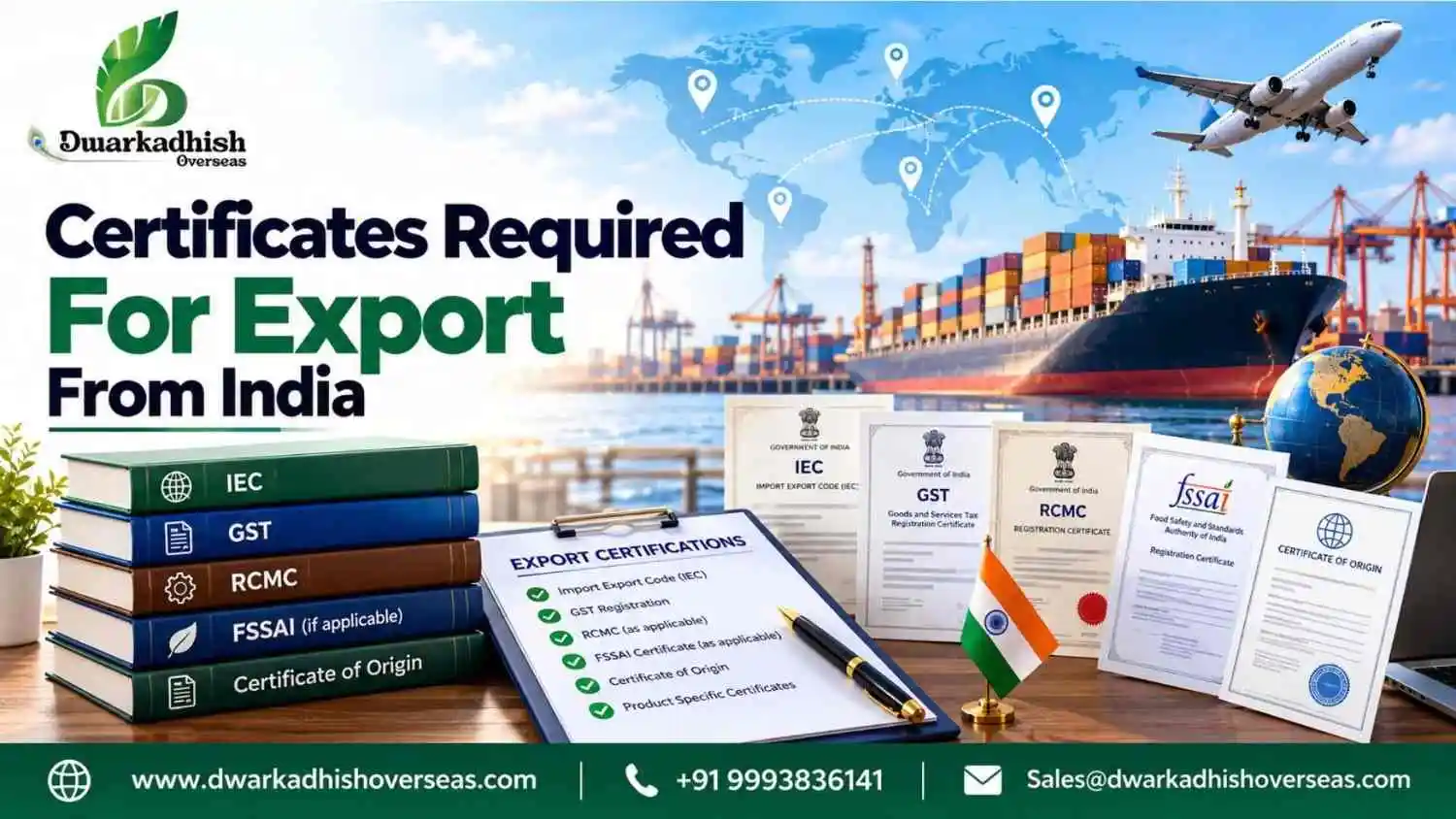
Planning to export goods from India? You must check which certificates your goods need before shipping. Missing a required certificate can delay your shipment. It can also cause problems with your overseas buyer.
The certificates required for export from India depend on your product and the country you want to ship to. For example, rice exporters may need a plant health certificate. Some food exporters need a health certificate. Other exporters may need a Certificate of Origin to claim lower import duty.
This guide covers the main export certificates in India. It explains who needs each certificate, who issues it and how to apply.
Table of Contents
- What Certificates Are Required for Export from India?
- Quick List of Export Certificates
- Importer Exporter Code (IEC)
- Certificate of Origin for Export
- Phytosanitary Certificate for Export
- Health or Sanitary Certificate for Export
- Fumigation Certificate for Export
- Export House Certificate and Star House Certificate
- Registration-cum-Membership Certificate (RCMC)
- EIA Inspection Certificate for Export
- Insurance Certificate for Export
- Bank Realisation Certificate (BRC or eBRC)
- Free Sale Certificate for Export
- Quality Certificate and Certificate of Conformity
- AD Code Registration for Export
- Other Product-Specific Export Certificates
- Preferential Certificates: SAFTA, GSP, EUR.1 and REX
- Certificates Required for Export of Food Items
- Export Certificate for Gold Jewellery
- How Can I Get an Export Certificate?
- Conclusion
- Frequently Asked Questions
- What is an export certificate?
- Is one certificate enough to export goods from India?
- Who issues export certificates in India?
- How do I check which certificates my product needs?
- Are export certificates and export documents the same?
- What is the cost of an export certificate in India?
- Can I export goods without a Certificate of Origin?
What Certificates Are Required for Export from India?
There is no single certificate for every export. Most goods exporters need an Importer Exporter Code (IEC). Other certificates depend on the product and the destination.
You may need a Certificate of Origin, phytosanitary certificate or health certificate. Some goods also need a fumigation certificate or a quality check.
Check the rules before shipping your goods. Your buyer may also ask for extra certificates.
Quick List of Export Certificates
| Certificate or registration | Who may need it | Issuing authority |
| Importer Exporter Code (IEC) | Most goods exporters | DGFT |
| Certificate of Origin | Exporters who need proof of origin | Approved issuing agency |
| Phytosanitary Certificate | Exporters of plants and plant products | Plant Quarantine authorities |
| Health Certificate | Exporters of certain food and animal products | Relevant authority |
| Fumigation Certificate | Exporters whose goods need pest treatment | Accepted fumigation provider |
| RCMC | Exporters who need it for certain benefits | Relevant export body |
| Export Inspection Certificate | Exporters of goods under inspection rules | Relevant inspection agency |
| Insurance Certificate | Exporters who need proof of cargo cover | Insurance company |
| eBRC | Exporters who need proof of payment received | DGFT system |
| Free Sale Certificate | Exporters of certain regulated products | Relevant authority |
| Certificate of Conformity | Products covered by safety or quality rules | Approved assessment body |
Not every exporter needs all these certificates. Check the rules for your product and destination before applying.
1. Importer Exporter Code (IEC)
An Importer Exporter Code is one of the first things most goods exporters need. The Directorate General of Foreign Trade (DGFT) issues it online.
You usually need an IEC to export goods from India. Some exporters may qualify for an exemption under the rules.
Who issues it? DGFT.
How to apply: Visit the DGFT website. Fill in the online form and provide the required business, PAN and bank details.
Check every detail before you submit the form. Wrong details can cause problems later.
2. Certificate of Origin for Export
A Certificate of Origin shows where goods come from under the rules that apply to them. Buyers and customs officers may ask for this certificate.
There are two main types:
- Non-preferential Certificate of Origin: Shows the origin of the goods.
- Preferential Certificate of Origin: Helps eligible exporters claim lower import duty under a trade deal.
Who issues it? An approved issuing agency.
How to Get Certificate of Origin for Export
First, ask your buyer which type of certificate is needed. Then check the rules for your product and destination.
Prepare the required papers and apply through the DGFT Certificate of Origin platform. Check the details before sending the certificate to your buyer.
Sending goods from India does not always mean they qualify for lower duty. Your goods must meet the rules of the trade deal.
3. Phytosanitary Certificate for Export
A phytosanitary certificate shows that plants or plant products meet the required plant health rules. It helps stop pests and plant diseases from spreading between countries.
Exporters of fruits, vegetables, seeds and grains may need this certificate. The rules depend on the product and the country receiving the goods.
Who issues it? Plant Quarantine authorities.
How to apply: Check the plant health rules of the destination country. Apply through the approved process. Arrange an inspection or treatment if needed.
Plant Quarantine Certificate for Export
Exporters may use this term when searching for a phytosanitary certificate. The exact rules depend on the goods and the destination.
For example, a rice exporter may need a plant health certificate. Some countries may also ask for extra details or pest treatment.
Check these rules before packing your goods. Some checks must be done before the shipment leaves India.
4. Health or Sanitary Certificate for Export
A health or sanitary certificate shows that certain goods meet health rules. It may be needed for food, meat, fish and other goods covered by these rules.
The issuing authority depends on the product. Some goods need a health check or lab test before the certificate can be issued.
Who issues it? The authority in charge of that product.
Health Certificate for Export of Food Products
Food exporters must check the rules in India and the destination country. Some products require a health certificate. Some may require lab reports and factory approval.
For example, fish exports may need special checks. Processed food may have different rules.
You should check what documents you will need to provide. An FSSAI Licence is not always a replacement for all health certificates required by another country.
5. Fumigation Certificate for Export
A fumigation certificate shows that goods or packing materials have had pest treatment. It may be needed for grains, pulses, wood and some other goods.
Some countries also have rules for wooden pallets and boxes. They may accept other approved treatments.
Who issues it? An accepted fumigation provider.
How to apply: Check whether your goods need treatment. Book an approved provider and check the certificate before shipping.
Fumigation is not needed for every export. Check the rules before paying for this service.
6. Export House Certificate and Star House Certificate
An Export House Certificate recognises exporters based on their export performance under India’s Foreign Trade Policy. It identifies businesses that meet the required export targets.
Export House status has five categories, from One Star to Five Star Export House. Each category has a different export performance threshold set by DGFT. Exporters must meet the current eligibility rules to qualify for a category.
Who issues it? DGFT.
How to apply: Check the latest rules on the DGFT website. Gather the required export records and submit your application online.
This certificate is not needed by every exporter. A business must meet the rules to apply.
7. Registration-cum-Membership Certificate (RCMC)
An RCMC shows that an exporter is registered with an export promotion body or a related authority.
You may need it to apply for certain export benefits or approvals. The right body depends on the products you sell.
Who issues it? The relevant export body or approved authority.
How to Get APEDA Certificate for Export
Exporters of products covered by APEDA may need an e-RCMC for certain benefits or services.
Get an IEC first, where required. Then check your product category and apply through the relevant DGFT process.
Visit the APEDA website for current rules. APEDA registration does not apply to every food or farm product.
8. EIA Inspection Certificate for Export
The Export Inspection Council (EIC) and its agencies inspect certain goods before export. These checks help ensure that goods meet the rules for their product type.
For example, fish and fishery products may need special checks before export. Other goods may follow different rules.
Who needs it? Exporters whose goods fall under inspection rules.
Who issues it? The relevant Export Inspection Agency.
Check whether your product needs an inspection before you apply. Visit the Export Inspection Council website for more details.
9. Insurance Certificate for Export
An insurance certificate shows that goods have cargo insurance. A buyer or bank may ask for it as proof of cover.
For example, an exporter may insure a machine during its journey to another country. The cover helps protect against risks listed in the policy.
Who issues it? An insurance company.
How to apply: Contact your insurer and share the shipment details. Check the cover, value and names on the certificate.
Not every export needs an insurance certificate. The contract and agreed trade terms decide when it is needed.
10. Bank Realisation Certificate (BRC or eBRC)
A Bank Realisation Certificate records payment received for exported goods or services. The electronic version is called an eBRC. It is handled through the DGFT system using payment details reported by banks.
Exporters may need it for payment records and certain trade benefits.
How to obtain it: Check the payment details in the DGFT system. Match them with your export records and follow the steps to generate the eBRC.
If a payment is missing, check the details and fix the issue first.
An eBRC proves payment details. It does not prove the quality or origin of goods.
11. Free Sale Certificate for Export
A Free Sale Certificate may show that a product can be sold in its home market. Some countries ask for it before they approve a product for sale.
It is used for certain regulated goods, including some health and medical products.
Who issues it? The authority in charge of the product.
Check the rules of the destination country before you apply. The right authority depends on the type of product.
12. Quality Certificate and Certificate of Conformity
A quality certificate or inspection report shows that goods meet set standards. A buyer may ask for it before accepting a shipment.
Who issues it? An approved inspection body or testing lab, as required.
CE Certificate for Export
Products placed on the market in the European Economic Area may need a CE marking to indicate that they meet applicable requirements.
Not all products will require CE marking. Always check what requirements apply to your product.
Some products need an outside check. For others, the maker can assess the product and prepare the required papers.
Certificate of Conformity (CoC)
A Certificate of Conformity shows that a product meets set safety or quality rules. Some countries ask for it before goods can enter their market.
Check the rules first. Use an approved body if the scheme requires one.
BIS Certificate for Export
BIS certification applies to products covered by certain Indian standards. It is not needed for every product exported from India.
Check whether your product falls under a compulsory scheme. The destination country may also have its own rules.
13. AD Code Registration for Export
An Authorised Dealer (AD) Code links an exporter to the bank that handles foreign trade payments. Exporters often need to register it for customs work.
The bank provides the code. The exporter then follows the customs or ICEGATE process.
How to apply: Get the required details or bank letter. Follow the steps for the customs location where you export goods. Check that the bank details are correct.
AD Code registration helps with export procedures. It is not a product certificate.
14. Other Product-Specific Export Certificates
Some certificates apply only to certain goods. Check the rules before you apply.
FSSAI Certificate for Export
Food businesses must follow the FSSAI rules that apply to them. An FSSAI licence does not replace every health certificate needed by another country.
Spice Board Certificate for Export
Spice exporters should check the rules for their products. Some may need registration, quality checks or other approvals.
GMP Certificate for Export
Good Manufacturing Practice (GMP) rules may apply to some medicines and health products. Check whether the destination needs a certificate, factory check or other approval.
MSDS Certificate for Export
A Material Safety Data Sheet (MSDS), now often called a Safety Data Sheet (SDS), explains the risks of a chemical. It also gives advice on safe use and handling.
It may be needed for chemicals and some dangerous goods. It is not an export licence.
SCOMET Certificate for Export
SCOMET rules cover certain chemicals, materials, equipment and technologies. Some goods need DGFT approval before export.
Check the current SCOMET list. Get the required approval before sending controlled goods.
Halal Certificate for Export from India
A Halal certificate may be needed for some food, meat and other products. The destination country may set rules for accepted certifiers.
Check which certificate your buyer or destination needs before you apply.
15. Preferential Certificates: SAFTA, GSP, EUR.1 and REX
These documents help eligible exporters claim lower import duty under certain trade deals. The right document depends on the country and the deal.
SAFTA Certificate for Export to Nepal
SAFTA supports trade between participating South Asian countries. Exporters sending goods to Nepal should check the product rules and origin conditions.
GSP Certificate for Export
The Generalized System of Preferences (GSP) gives trade benefits under certain schemes. Check whether the destination’s current scheme covers your product.
EUR.1 Certificate for Export
An EUR.1 certificate helps prove origin under certain trade deals. It is not needed for every export to Europe.
Check the rules of the trade deal before applying.
REX Certificate for Export
The Registered Exporter (REX) system lets eligible exporters make statements about the origin of their goods. It applies only to certain trade schemes.
Check whether your destination and product need REX registration.
LUT for Export under GST
A Letter of Undertaking (LUT) lets eligible registered businesses export goods or services without paying IGST at the time of export, subject to GST rules.
An LUT is a tax document, not a product certificate. Check the current GST rules before filing it.
16. Certificates Required for Export of Food Items
Food exporters may need different certificates for different products. The rules also change by destination.
Check whether you need:
- An FSSAI licence for your food business.
- APEDA or other registration, where required.
- A health certificate.
- A phytosanitary certificate for plant products.
- A fumigation certificate, if treatment is needed.
- Lab reports or inspection records.
- A Certificate of Origin, if required.
Certificate Required for Rice Export from India
Rice exporters should check the rules of the destination country. A phytosanitary certificate may be needed to show that the rice meets plant health rules.
A health certificate for rice export from India is not needed for every shipment. Check the exact rules before dispatch.
17. Export Certificate for Gold Jewellery
Gold jewellery exports may need customs papers and details about the goods. The rules may differ for plain jewellery and jewellery with precious stones.
There is no single export certificate for every gold jewellery shipment. Check the customs rules and buyer’s needs before shipping.
18. How Can I Get an Export Certificate?
The steps depend on the certificate you need. Follow these basic steps to avoid delays.
- Identify your product. Check the type of goods you plan to export.
- Check the destination. Find out which certificates the country needs.
- Find the right authority. This may be DGFT, APEDA or Plant Quarantine.
- Prepare the papers. Gather invoices, product details and test reports, if needed.
- Apply for the certificate. Use the correct website or application process.
- Complete checks. Arrange any required tests or inspections.
- Review the certificate. Check the product and shipment details before dispatch.
Start early if your goods need tests or treatment. Some certificates must be ready before the shipment leaves India.
Conclusion
The certificates required for export from India depend on your product and destination. Most goods exporters need an IEC. Other certificates apply only to certain goods or trade deals.
Check the rules before you ship. Apply through the right authority and keep the required papers ready. This can help you avoid delays and make the export process easier.
Frequently Asked Questions
1. What is an export certificate?
An export certificate proves a specific detail about goods or a shipment. It may confirm origin, health, quality or safety. The required certificate depends on the product, destination and rules that apply to the export.
2. Is one certificate enough to export goods from India?
Not always. Most goods exporters need an IEC unless an exemption applies. Other certificates depend on the product and destination. Check the rules before shipping to avoid missing papers or delays during customs clearance.
3. Who issues export certificates in India?
Different authorities issue different certificates. DGFT handles IEC and the relevant origin process. Plant Quarantine authorities issue phytosanitary certificates. Other bodies handle product checks, health certificates and approvals based on the goods being exported.
4. How do I check which certificates my product needs?
Identify your product and destination first. Then check Indian export rules, destination requirements and buyer conditions. Contact the relevant authority to confirm the final list before shipping your goods from India.
5. Are export certificates and export documents the same?
No. Export documents include invoices, packing lists and shipping bills. Certificates prove details such as origin, health or quality. A shipment may need both, depending on the product, destination and customs rules.
6. What is the cost of an export certificate in India?
The cost depends on the certificate and product. You may need to pay application, testing or inspection fees. Check the official website of the issuing authority to confirm the latest charges before applying.
7. Can I export goods without a Certificate of Origin?
Yes, if your shipment does not require one. However, your buyer or the destination country’s customs office may ask for it. You may also need it to claim lower import duty under a trade agreement.